Search Engine

Custom Search
Showing posts with label Porsche Carrera. Show all posts

Wednesday, September 30, 2015

A low-down look at the QNX concept cars

Paul Leroux
It’s that time of year again. The QNX concept team has set the wheels in motion and started work on a brand new technology concept car, to be unveiled at CES 2016.

The principle behind our technology concept cars is simple in theory, but challenging in practice: Take a stock production vehicle off the dealer’s lot, mod it with new software and hardware, and create user experiences that make driving more connected, more enjoyable, and, in some cases, even safer.

It’s always fun to guess what kind of car the team will modify. But the real story lies in what they do with it. In recent years, they’ve implemented cloud-based diagnostics, engine sound enhancement, traffic sign recognition, collision warnings, speed alerts, natural voice recognition — the list goes on. There’s always a surprise or two, and I intend to keep it that way, so no hints about the new car until CES. ;-)

In the meantime, here is a retrospective of QNX technology concept cars, past and present. It’s #WheelWednesday, so instead of the usual eye candy, I’ve chosen images to suit the occasion. Enjoy.

The Maserati Quattroporte GTS
From the beginning, our technology concept cars have demonstrated how the QNX platform helps auto companies create connected (and compelling) user experiences. The Maserati, however, goes one step further. It shows how QNX can enable a seamless blend of infotainment and ADAS technologies to simplify driving tasks, warn of possible collisions, and enhance driver awareness. The car can even recommend an appropriate speed for upcoming curves. How cool is that?


The Mercedes CLA 45 AMG
By their very nature, technology concept cars have a short shelf life. The Mercedes, however, has defied the odds. It debuted in January 2014, but is still alive and well in Europe, and is about to be whisked off to an event in Dubai. The car features a multi-modal user experience that blends touch, voice, physical buttons, and a multi-function controller, enabling users to interact naturally with infotainment functions. The instrument cluster isn’t too shabby, either. It will even warn you to ease off the gas if you exceed the local speed limit.


The Bentley Continental GT
I dubbed our Bentley the “ultimate show-me car,” partially because that’s exactly what people would ask when you put them behind the wheel. The digital cluster was drop-dead gorgeous, but the head unit was the true pièce de résistance — an elegantly curved 17” high-definition display based on TI’s optical touch technology. And did I mention? The car’s voice rec system spoke with an English accent.


The Porsche 911 Carrera
Have you ever talked to a Porsche? Well, in this case, you could — and it would even talk back. We outfitted our 911 with cloud-based voice recognition (so you could control the nav system using natural language) and text-to-speech (so you could listen to incoming BBMs, emails, and text messages). But my favorite feature was one-touch Bluetooth pairing: you simply touched your phone to an NFC reader in the center console and, hey presto, the phone and car were automatically paired,


The Chevrolet Corvette
I have a confession to make: The Corvette is the only QNX technology concept car that I got to drive around the block. For some unfathomable reason, they never let me drive another one. Which is weird, because I saw the repair bill, and it wasn’t that much. In any case, the Corvette served as the platform for the very first QNX technology concept car, back in 2010. It included a reconfigurable instrument cluster and a smartphone-connected head unit — features that would become slicker and more sophisticated in our subsequent concept vehicles. My favorite feature: the reskinnable UI.


The Jeep Wrangler
Officially, the Wrangler serves as the QNX reference vehicle, demonstrating what the QNX CAR Platform can do out of the box. But it also does double-duty as a concept vehicle, showing how the QNX platform can help developers build leading-edge ADAS solutions. My favorite features: in-dash collision warnings and a fast-booting backup display.


Well, there you have it. In just a few months’ time, we will have the honor of introducing you to a brand new QNX technology concept car. Any guesses as to what the wheels will look like?


If you liked this post, you may also be interested in... The lost concept car photos

Monday, June 29, 2015

The A to Z of QNX in cars

Over 26 fast facts, brought to you by the English alphabet

Paul Leroux
A is for Audi, one of the first automakers to use QNX technology in its vehicles. For more than 15 years, Audi has put its trust in QNX, in state-of-the-art systems like the Audi virtual cockpit and the MIB II modular infotainment system. A is also for QNX acoustics software, which enhances hands-free voice communications, eliminates “boom noise” created by fuel-saving techniques, and even helps automakers create signature sounds for their engines.

B is for Bentley, BMW, and Buick, and for their QNX-powered infotainment systems, which include BMW ConnectedDrive and Buick Intellilink.

C is for concept vehicles, including the latest QNX technology concept car, a modded Maserati Quattroporte GTS. The car integrates an array of technologies — including cameras, LiDAR, ultrasonic sensors, and specialized navigation engines — to show how QNX-based ADAS systems can simplify driving tasks, warn of possible collisions, and enhance driver awareness.

D is for the digital instrument clusters in vehicles from Alpha Romeo, Audi, GM, Jaguar, Mercedes-Benz, and Land Rover. These QNX-powered displays can reconfigure themselves on the fly, providing quick, convenient access to turn-by-turn directions, back-up video, incoming phone calls, and a host of other information.

E is for experience. QNX has served the automotive market since the late 1990s, working with car makers and tier one suppliers to create infotainment systems for tens of millions of vehicles. QNX has been at work in safety-critical industrial applications even longer — since the 1980s. This unique pedigree makes QNX perfectly suited for the next generation of in-vehicle systems, which will consolidate infotainment and safety-related functions on a single, cost-effective platform.

F is for Ford, which has chosen the QNX Neutrino OS for its new SYNC 3 infotainment system. The system will debut this summer in the 2016 Ford Escape and Ford Fiesta and will be one of the first infotainment systems to support both Apple CarPlay and Android Auto.

G is for GM and its QNX-based OnStar system, which is now available in almost all of the company’s vehicles. GM also uses QNX OS and acoustics technology in several infotainment systems, including the award-winning Chevy MyLink.

H is for hypervisor. By using the QNX Hypervisor, automotive developers can consolidate multiple OSs onto a single system-on-chip to reduce the cost, size, weight, and power consumption of their designs. The hypervisor can also simplify safety certification efforts by keeping safety-related and non-safety-related software components isolated from each other.

I is for the ISO 26262 standard for functional safety in road vehicles. The QNX OS for Automotive Safety has been certified to this standard, at Automotive Safety Integrity Level D — the highest level achievable. This certification makes the OS suitable for a wide variety of digital clusters, heads-up displays, and ADAS applications, from adaptive cruise control to pedestrian detection.

J is for Jeep. The QNX reference vehicle, based on a Jeep Wrangler, showcases what the QNX CAR Platform for Infotainment can do out of the box. In its latest iteration, the reference vehicle ups the ante with traffic sign detection, lane departure warnings, curve speed warnings, collision avoidance alerts, backup displays, and other ADAS features for enhancing driver awareness.

K is for Kia, which uses QNX technology in the infotainment and connectivity systems for several of its vehicles.

L is for LG, a long-time QNX customer that is using several QNX technologies to develop a new generation of infotainment systems, digital clusters, and ADAS systems for the global automotive market.

M is for Mercedes-Benz, which offers QNX-based infotainment systems in several of its vehicles, including the head unit and digital instrument cluster in the S Class Coupe. M is also for market share: according to IHS Automotive, QNX commands more than 50% of the infotainment software market.

N is for navigation. Thanks to the navigation framework in the QNX CAR Platform, automakers can integrate a rich variety of navigation solutions into their cars.

O is for the over-the-air update solution of the BlackBerry IoT Platform, which will help automakers cut maintenance costs, reduce expensive recalls, improve customer satisfaction, and keep vehicles up to date with compelling new features long after they have rolled off the assembly line.

P is for partnerships. When automotive companies choose QNX, they also tap into an incredibly rich partner ecosystem that provides infotainment apps, smartphone connectivity solutions, navigation engines, automotive processors, voice recognition engines, user interface tools, and other pre-integrated technologies. P is also for Porsche, which uses the QNX Neutrino OS in its head units, and for Porsche 911, which formed the basis of one of the first QNX concept cars.

Q is for the QNX CAR Platform for Infotainment, a comprehensive solution that pre-integrates partner technologies with road-proven QNX software to jump-start customer projects.

R is for the reliability that QNX OS technology brings to advanced driver assistance systems and other safety-related components in the vehicle — the same technology proven in space shuttles, nuclear plants, and medical devices.

S is for the security expertise and solutions that Certicom and QNX bring to automotive systems. S is also for the advanced smartphone integration of the QNX CAR Platform, which allows infotainment systems to support the latest brought-in solutions, such as Apple CarPlay and Android Auto. S is also for the scalability of QNX technology, which allows customers to use a single software platform across all of their product lines, from high-volume economy vehicles to luxury models. And last, but not least, S is for the more than sixty million vehicles worldwide that use QNX technology. (S sure is a busy letter!)

T is for Toyota, which uses QNX technology in infotainment systems like Entune and Touch ‘n’ Go. T is also for tools: using the QNX Momentics Tool Suite, automotive developers can root out subtle bugs and optimize the performance of their sophisticated, multi-core systems.

U is for unified user interface. With QNX, automotive developers can choose from a rich set of user interface technologies, including Qt, HTML5, OpenGL ES, and third-party toolkits. Better yet, they can blend these various technologies on the same display, at the same time, for the ultimate in design flexibility.

V is for the Volkswagen vehicles, including the Touareg, Passat, Polo, Golf, and Golf GTI, that use the QNX Neutrino OS and QNX middleware technology in their infotainment systems.

W is for the QNX Wireless Framework, which brings smartphone-caliber connectivity to infotainment systems, telematics units, and a variety of other embedded devices. The framework abstracts the complexity of modem control, enabling developers to upgrade cellular and Wi-Fi hardware without having to rewrite their applications.

X, Y, and Z are for the 3D navigation solutions and the 3D APIs and partner toolkits supported by the QNX CAR Platform. I could show you many examples of these solutions in action, but my personal favorite is the QNX technology concept car based on a Bentley Continental GT. Because awesome.

Before you go... This post mentions a number of automotive customers, but please don’t consider it a complete list. I would have gotten them all in, but I ran out of letters!

Monday, July 21, 2014

The lost concept car photos

Have you ever rummaged through old boxes in your basement and discovered family photos you had totally forgotten about — or never knew existed? I experienced a moment like that a couple of weeks ago. Except, in this case, no basement was involved. And the box wasn't a box, but a shared drive. And the photos weren't of my family, but of cars. QNX technology concept cars, to be exact.

At least once a year, the QNX concept team retrofits a new vehicle to demonstrate how our technology can help auto companies push the envelope in connectivity, infotainment, and acoustics. And, in every case, we take pictures — sometimes, lots of them. Inevitably, we end up choosing a few images for publicity purposes and filing the others. But as I discovered, the images we don't use are often just as good as the ones we do use. We just don't need all of them!

In any case, stumbling across these photos was great fun. I thought you might enjoy them, too, so here goes...

The Porsche
First up is the QNX technology concept car based on a Porsche 911, which made its debut at 2012 CES. We had originally planned to drive the car back to Ottawa once CES was over — but that was before we spoke to our friends at Texas Instruments, who provided the silicon for the car's instrument cluster and infotainment system. They liked the car so much, they asked if we could bring it to their HQ in Dallas, where the following two photos were taken. All I can say is, Dallas is home to at least one awesome cool photographer. Because rather than curse the crazy lighting, the photographer used it to create some playful compositions:


If you look below, you'll see another shot of the Porsche, taken just before we shipped it off to CES. The image really doesn't belong in this collection, as it appeared once on a partner website. But it's rare nonetheless, so I decided to include it. And besides, it's cool. Literally.


Did you know? The original Porsche 911, which debuted in the early 60s, was dubbed the 901. Problem was, Peugeot had exclusive rights in France to three-digit car names with a 0 in the middle. And so, the 901 became the 911.


The Bentley
Next up is the QNX technology concept car based on a Bentley Continental GT. In this image, the driver is interacting with the center stack's main control knob, which was mounted directly on a 17" touchscreen. See the row of icons just above the knob? These represented HVAC, music, navigation, hands-free calling and other system functions. The  system would automatically display these icons as your hand approached the display; you would then turn the knob to choose the function you wanted. (This image was taken by a BlackBerry employee, whose name I have most ungraciously forgotten.)


As with our all concept vehicles, the intent was to showcase the technology that we had built into the car's dashboard and center stack. Which probably explains why the following image of the car's exterior was never published. Pity, as it's quite lovely — a classic case of flare adding flair.


Did you know? Those wheels aren't just for show. The Bentley comes equipped with a 616 hp W12 engine (yup, three banks of cylinders) that can do 0-60 mph in a little over 4 seconds — it took me way longer than that to type this sentence.


The Jeep
Next up is the Jeep Wrangler, which serves as the QNX reference vehicle. The Jeep plays a different role than the other vehicles highlighted here: instead of demonstrating how QNX technology can help automotive companies innovate, it shows what the QNX CAR Platform for Infotainment can do right out of the box. In this image, you can see the vehicle's main navigation menu:


Did you know? The original infotainment system in the reference vehicle could post Facebook updates that listed the title and artist of the song currently playing. The system performed this magic in response to simple voice commands.


The Vette
The QNX technology concept car based on a Chevrolet Corvette made its debut at SAE Convergence 2010. Among other things, it showed how digital instrument clusters can morph on the fly to provide drivers with context-sensitive information, such as turn-by-turn directions. You can see a slicker, more sophisticated approach to reconfigurable clusters in our most recent technology concept car based on a Mercedes CLA45.


Did you know? We used the Corvette to demonstrate how QNX technology enables automotive companies to create customizable, reskinnable user interfaces. Check out this post on the Corvette's 30-day UI challenge.


The Prius
The first QNX-powered technology concept car was a digitally modded Prius — aka the LTE Connected Car. The car was a joint project of several companies, including QNX and Alcatel-Lucent, who wanted to demonstrate how 4G/LTE networks could transform the driving experience with a host of new in-vehicle applications.

Here's the car with a very proud-looking Derek Kuhn, who spearheaded the LTE Connected Car project while serving as a VP at Alcatel-Lucent. Derek subequently joined QNX as VP of sales and marketing:


Did you know? When this car was created, telecom companies had yet to light up their first commercial LTE towers. Also, the car had more infotainment systems than any other QNX technology concept car: two in the front (one for the driver and one for the front-seat passenger) and two in the back.


Some things get lost, albeit temporarily. And some you just never see again. Fortunately, all these images belong to the first category. Any favorites?

Tuesday, February 4, 2014

Head to the polls and vote for your favorite CES Car of Fame

Over the last couple of months we have recapped the stars of the QNX garage – our technology concept cars and reference vehicle — in the CES Cars of Fame series. And now, we are opening the floor to you!

Starting today through February 14 you can vote for your favorite vehicle that we have featured at CES. Did the eye-catching Bentley strike your fancy or did the updated Jeep put you into another gear? It’s all up to you. We will announce the fan favorite on Tuesday, February 18.

So once again here is the full list of our CES Cars of Fame blog posts. Have one last look and cast your vote:

Cast your vote here.

Thursday, December 5, 2013

A Porsche you could talk to

Paul Leroux
I have a confession to make. The day before QNX Software Systems unveiled this technology concept at car at 2012 CES, I leaked the news on the On Q blog. Mind you, the leak was unintentional. I had been editing a post that described the car and, instead of hitting Save, I hit Publish by mistake. Dumb, I know.

I immediately took down the post and informed my colleagues of the error. Fortunately, my RSS feed didn't give me away, and the launch, which had been strictly under wraps, went ahead as planned. But boy, did I feel stupid.

Now that I've got that off my chest, let's see what the hubbub was about. The car, based on a Porsche 911 Carrera, came equipped with an array of features built by the QNX concept team, including one-touch smartphone pairing, high-definition hands-free calls, rear-seat entertainment, and a digital instrument cluster.

So, you ready for a tour?

The car
Let's start with the exterior. Because man, what an exterior:


The instrument cluster
Once you got behind the wheel, the first thing you saw was the instrument cluster. But
this was no ordinary cluster. It could dynamically reconfigure itself — in response to voice commands, no less. It could even communicate with the navigation system to display turn-by-turn directions. And it was designed to honor the look-and-feel of the stock 911 cluster:


The head unit
To your right, you could see the head unit. Here is the unit's main screen, from which you could access all of the system's key functions:


And here's another screen, showing the system's media player:


The front-seat control of backseat infotainment
The Porsche also showcased how a head unit could offer front-seat control of backseat entertainment — perfect for when you need to control what your kids are watching or listening to:


The voice recognition
The Porsche was outfitted with cloud-based voice recognition, which let you enter navigation destinations naturally, without having to use artificial grammars. Check out this Engadget clip, taken at an AT&T event in New York City:


The car also included features that neither words nor pictures can capture adequately. But let me try, anyway:

One-touch Bluetooth pairing — Allowed you to pair a phone to the car simply by touching the phone to an NFC reader embedded in the center console; no complicated menus to wade through.

Text-to-speech integration — Could read aloud incoming emails, text messages, and BBM messages.

High-definition voice technology — Used 48KHz full stereo bandwidth for clear, high-fidelity hands-free calls.

The car also ran a variety of apps, including TCS hybrid navigation, Vlingo voice-to-text, Poynt virtual assistant, Weather Network, and streaming Internet radio from Pandora, Nobex, Slacker, and TuneIn.

The point
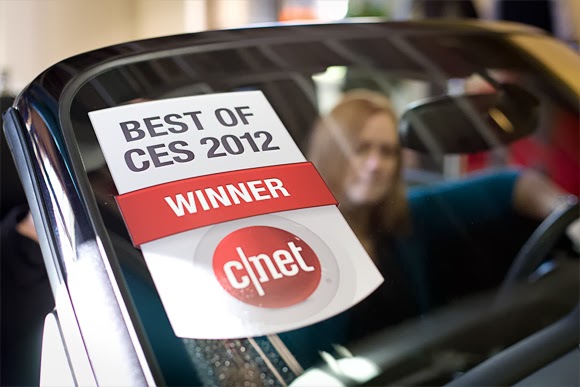
The point of this car wasn't simply to be cool, but to demonstrate what's possible in next-gen infotainment systems. More specifically, it was designed to showcase the capabilities of the QNX CAR Platform for Infotainment. In fact, it did such a good job on that count that the platform took home the 2012 CES Best of Show award, in the car tech category: